
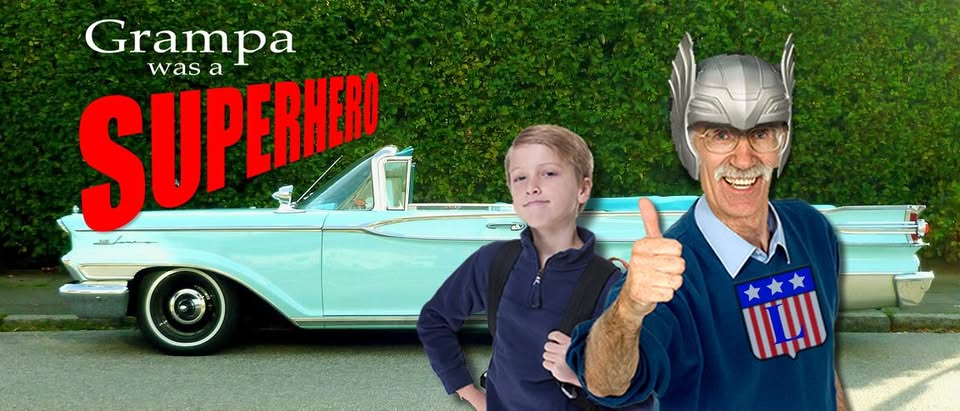
“Grampa Was A Superhero” is a feature screenplay I wrote in partnership with my pal Sean Meehan.
We felt like it turned out pretty good, and that sense was reinforced by the industry.
It was optioned for two years by a producer who’d previously worked extensively with Stephen King.
Sadly, the indie market was still reeling from the recession, and we weren’t able to pull together the funding. Eventually, the option lapsed and we got it back.
We Moved On
We blamed the script’s lack of momentum on the recession, and didn’t make any revisions.
Instead, we went on to write “Faeries: Rise of the Sin Eaters”, a creature feature horror script. It quickly became a finalist in the Shriekfest Screenplay Contest and went under option several times to different companies.
Then we wrote a third, a western-genre mashup of epic proportions.
Then We Came Back
Eventually, we decided it was time to start marketing the Grampa script again. We didn’t plan on doing any rewrites… it had already been optioned once, so it must be in good shape, right?
So imagine my dismay when I read it through before sending it out, and discovered that it sucked.
Okay, it didn’t suck
Okay, maybe it didn’t suck. It’s a great story, with real four-quadrant appeal, and characters that we think actors will want to play. Plus, it’s got franchise written all over it, and cross-media potential in graphic novels, TV or web series, and maybe even action figures. (A guy can dream, right?)
So yeah, it was good. But it wasn’t good enough.
What The Problem Was
Here’s the thing. Essentially it’s a family road trip adventure story, in the vein of Home Alone, Wild Hogs, Are We There Yet, or Unaccompanied Minors.
But given that genre, it’s a complicated story: Jesse and his Grampa are on an unplanned road trip (that’s plot one), a pair of bumbling robbers are working their way across the country on the same route (that’s our B story), an aspiring TV reporter is abusing his network’s resources to keep them on the road and in the news (that’s subplot one), and Jesse’s parents are trying to figure out where the two traveler’s have disappeared to (that’s subplot two).
Add to that the fact that Grampa’s living in a dream world where he thinks he’s a super hero, because he used to play one on TV in the ’60′s, and there’s a lot of there there.
So what we discovered was that while all those plots intertwine in ways that organically build on one another (there are good story reasons why one plot is facilitated by another), we’d given them all nearly equal weight.
And what the story really needed to be about was Jesse and his Grampa.
So I went to my writing partner and told him the bad news.
The Bad News
Sean balked. He hadn’t thought about this screenplay for years and was confident it surely must be good enough.
I convinced him to read through my notes and keep an open mind.
And sure enough, he saw what I was saying.
At 110 pages it was just too fat. Some of that was too much plot, some of it was overwritten description.
And it suffered from a lack of focus. We needed to pare down the subplots and put the focus back on Jesse and Grampa.
So began the gutting.
What We Did
We’ve spent some time studying the art of the rewrite and have blogged about interpreting screenplay feedback and integrating value back into your story.
I won’t bore you with the details of the rewrite. But trust me, we gutted a lot of stuff.
We lost lots of great dialogue we loved when we wrote it, and still think is great stuff. For another movie.
We lost whole themes about timely and interesting things: how we live in a consumerist society that values acquisition over honor, money over integrity, fame over achievement. None of which really belonged in a movie modeled after Home Alone.
We lost five pages just by simplifying the motivations of a single minor character.
Another five by editing the description to be more concise.
Another three or four by killing really cute scenes that weren’t actually moving the story forward.
In the end we stripped twenty pages — twenty pages! — from what we thought surely was a solid screenplay, that had been good enough to be optioned (and extended) for two years.
What We Got
Now Grampa Was A Superhero is a much more concise, tight, fast-moving story that more closely matches its brethren in the genre. It’s funnier, faster, leaner and meaner.
And we’ve got high hopes for this new, improved screenplay.
Should You Rewrite Your Old Work?
While I don’t recommend rewriting and rewriting screenplays forever (click here to read how that can become a problem) it’s important to recognize that you do learn and grow as you write.
You’re a better writer now than the person who wrote that screenplay. So don’t let that less experienced writer of the past ignore the advice of the better and more talented writer you’ve become.
You need to be willing to be brutally honest with yourself, be your own worst critic, and listen to what your new and more insightful gut is telling you.
You’ll gain confidence, because you’ll see that you can now recognize your mistakes, that it’s possible to find ways to improve even solid work, and that good enough can be better.
It’s valuable to learn how to kill your babies, and get rid of paragraphs of what you’ve thought for months or years might be great dialogue, if losing it is in service of a better story.
It’s valuable to be willing to acknowledge that the great themes you wove into your work aren’t appropriate or necessary to the movie you’re writing and are muddying the message.
And yes, if the story is a good one and you can fix it in relatively short order, it is worth spending some time to do it. Hopefully, you’ll end up with a much stronger screenplay (we did).
So go. Reread. Rewrite. Grow.
Have you had good or bad experiences with rewrites? Share in the comments!
 Chip Street - Writey Guy