

We’ve seen plenty written on the filmmaker’s experience in crowdfunding. But what’s it like from the backer’s point of view?
Crowdfunding your film? It’s time to think like a marketer.
Kickstarter’s recent Sundance report outlined the real numbers behind success or failure in Kickstarter crowdfunding — see it summarized in this John August blog posting.
According to that Kickstarter report, only about 45% of projects on their platform hit their funding goals (and on Kickstarter, where hitting your goal is a requirement to releasing funds, that means 55% don’t get anything). And of those that get funding, most of it comes from a known audience — people the filmmaker already knows.
Now, if you want to be in that 45% of successful crowdfunders, and if you want to get backing from more than your own small circle of friends, you need to think of your potential backers as customers … and your project as an opportunity (or an obligation) to convert.
You need to find a way to touch that untapped pool of potential backers – to get them to your project’s site, and then to convert them into backers willing to part with their hard-earned money.
What makes a backer a backer?
Let’s take a peek at the backer’s experience.
Over at Moments Of Film, Leilani Holmes wrote a beautiful post that outlines her reasons for backing 14 projects over the past two years, why she chose them, and what she got (or didn’t get) out of the experience.
What is exceptional about what you’re doing? Why should it interest anyone other than yourself to make it? An earnest plea for ‘help’ because you’re nice and you want to make a film but need support, doesn’t really cut the mustard as much as something that holds real innovation that inspires others to want to be part of it.
— Leilani Holmes
If you want to get any kind of sense as to why potential backers decide to kick in on a crowdfunding project, this article is a great place to start. Because if you want to increase conversions, you have to know who your customer is, what appeals to them, and how to speak to them in a language they’ll understand.
Conversion defined
What’s a conversion? From MarketingTerms.com (emphasis ours):
Conversion Rate is the percentage of visitors who take a desired action.
The desired action can take many forms, varying from site to site. Examples include sales of products, membership registrations, newsletter subscriptions, software downloads, or just about any activity beyond simple page browsing.
A high conversion rate depends on several factors, all of which must be satisfactory to yield the desired results — the interest level of the visitor, the attractiveness of the offer, and the ease of the process.
The interest level of the visitor is maximized by matching the right visitor, the right place, and the right time.
The attractiveness of the offer includes the value proposition and how well it is presented. It is worth noting that small, impulse items typically have a higher conversion rate than large, shopping items.
The visitor’s ease of completing the desired action is dependent on site usability which includes intuitive navigation and fast loading pages.
— Marketing Terms dot com
Conversion means getting your potential customer to take the action you want them to take.
Conversion is turning visitors into customers.
What’s your job?
Let’s assume that Kickstarter, or IndieGoGo, or SoKap, or whichever crowdfunding platform you’re using, will take care of issues like “intuitive navigation and fast loading pages”.
That means it’s your job to:
- present the offer well
- gain the interest of the visitor
- make the offer attractive
- and make it easy to complete.
Why does most of the money come from family and friends?
So why is it that successful crowdfunding filmmakers get most of their money from people they already know?
Because they’re filmmakers, not marketers. They likely write their copy and pitch the value and benefits of their project in terms that filmmakers (or people who know filmmakers) relate to. That’s conversion 101 – “speak to the dog in the language of the dog, of things that are close to the heart of the dog.”
In other words, they present their offer in language and terms they understand themselves. Essentially, they pitch as if they were pitching themselves, and thus their offer appeals to people like them (filmmakers) or people who know them and are already sympathetic to them (family and friends).
There are two problems with this: Other indie filmmakers are notoriously without money to share, and you don’t need crowdfunding services to access your friends and family.
To convert the rest of the audience, the people you don’t know, the people with money, you need to present to them in ways that appeal to them, and compel them to support you.
Four personality types to appeal to
If your mother was anything like ours, you heard this a lot: “It’s not just what you say, it’s how you say it.” In conversion, it’s not enough to have a great project. You need to organize your information, and craft your language, in ways that appeal to a variety of audiences — and personality types — to compel them to action.
In conversion (or persuasion) theory, there are four fundamental personas, or ‘psychological profiles’, that your pitch/copy/content needs to appeal to.
- Competitive
- Spontaneous
- Methodical
- Humanistic
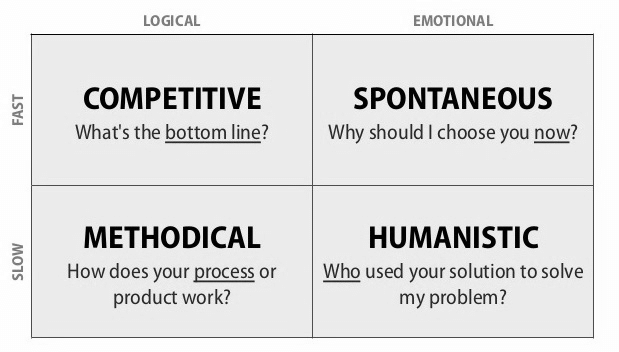
These four personas live on a scale with two axes: Logical to Emotional, and Quick to Deliberate.
And conversion expert Bryan Eisenberg talks about them here:
So who’s your customer?
So what’s on your potential customer’s mind?
Why should they back your project instead of someone else’s?
You need to think about all the possible kinds of people who might be viewing your crowdfunding project, and speak to them in terms that appeal to them.
You need to remember that you’re not the audience.
You need to think like a marketer. Not a filmmaker.
And that’s why it’s hard.
Good luck. And if you’ve got crowdfunding success stories — or lessons learned the hard way — we’d love to hear about them.
 Chip Street - Writey Guy